A Year of Japanese Seasonal Celebrations You Can Actually Do at Home in America
Most Americans who fall in love with Japanese culture eventually hit the same wall. They know about cherry blossom season. They've heard of New Year's. But the rest of Japan's incredibly rich seasonal calendar — the winter bean-throwing, the summer lantern festivals, the autumn moon-gazing — stays mysterious, something that happens over there, not something you can actually participate in from an apartment in Denver or a house in suburban Atlanta.
Here's the thing: you absolutely can. Japan's traditional seasonal observances were never really about geography. They're about attention — to the turning of the year, to the people you love, to the food that tastes like right now and nowhere else. That's entirely portable.
This is your year-round guide to celebrating Japan's seasonal traditions with genuine care and a whole lot of good food.
February: Setsubun — Chase the Demons Out
Setsubun falls on February 3rd, the day before the traditional start of spring in the old Japanese lunar calendar. The central ritual is mamemaki — scattering roasted soybeans while shouting "Oni wa soto! Fuku wa uchi!" (Demons out! Good fortune in!). Traditionally, the head of the household wears an oni mask while family members throw beans at them. It's chaotic and wonderful.
For your American home, grab a bag of roasted edamame or soybeans from a Japanese grocery store or Amazon. Make or buy a simple oni mask (there are great printable versions online). Do the bean-throwing — outside if you want to keep the mess manageable. Then eat one soybean for each year of your age, which is supposed to bring good health for the coming year.
The food centerpiece of modern Setsubun is ehomaki — a thick sushi roll you eat in complete silence while facing the year's lucky compass direction. Look up the current year's lucky direction (it rotates on a traditional cycle), make or order a fat futomaki roll, and eat the whole thing without cutting it. No talking. The unbroken roll symbolizes unbroken good luck. It's genuinely a fun dinner party ritual.
March/April: Hanami — The Art of Paying Attention to Flowers
Cherry blossom season is the one everyone knows, but most Americans experience it as a photo opportunity rather than a philosophy. Hanami — literally "flower viewing" — is a practice of gathering under blooming trees with food, drink, and people you love, specifically to appreciate something beautiful and temporary.
The Japanese concept of mono no aware — a gentle sadness at the transience of things — is baked into hanami. The blossoms are beautiful because they don't last. Sitting with that feeling, together, is the whole point.
You don't need a Japanese cherry tree. Find whatever is blooming near you in early spring — crabapples, Bradford pears, redbuds — and throw a proper picnic underneath. Pack onigiri, tamagoyaki, and some good tea in a thermos. Leave your phone in your bag for at least part of it. Talk about what's changing in your lives. That's hanami.
July: Tanabata — Write Your Wishes on the Stars
Tanabata, celebrated on July 7th, is one of the most visually gorgeous holidays in the Japanese calendar. It commemorates the legend of two star-crossed lovers — Orihime and Hikoboshi, represented by the stars Vega and Altair — who are separated by the Milky Way and allowed to meet only once a year.
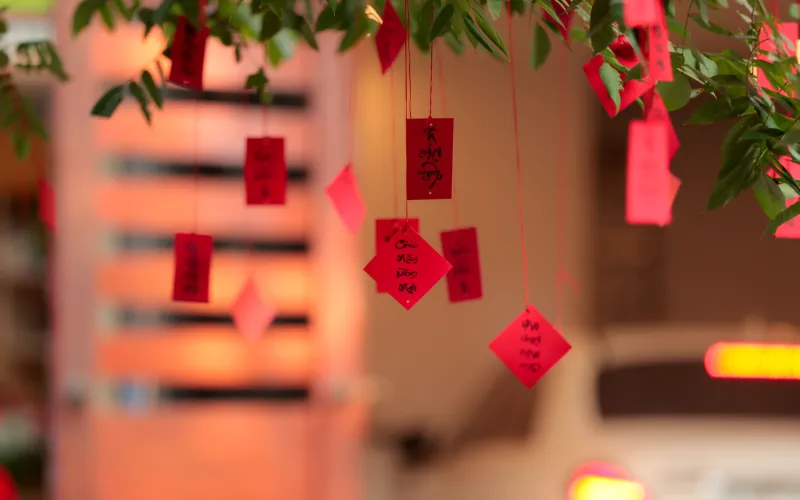
The tradition involves writing wishes on strips of colored paper called tanzaku and hanging them on bamboo branches. Walk through any Japanese city in early July and the bamboo decorations are absolutely stunning — cascades of paper wishes in every color, fluttering in the summer heat.
For your home: grab some bamboo from a craft store or a garden center, cut strips of colored paper, and invite everyone in your household to write wishes — real ones, not jokey ones. Hang them up. Leave them for a week. The act of articulating what you actually want, and sharing it with the people around you, is quietly powerful. Many families make this a dinner tradition with cold somen noodles, which are traditional Tanabata food.
August: Obon — Honoring Those Who Came Before
Obon is a Buddhist observance typically held in mid-August, and it's one of the most moving traditions in the Japanese year. The belief is that during Obon, the spirits of ancestors return to visit their living family members. Families clean graves, light welcoming fires called mukaebi at their doorsteps, and gather together. The celebration ends with okuribi — sending fires to guide the spirits back.
Obon is also associated with Bon Odori — community folk dances held at local festivals, which are genuinely some of the most joyful public events in Japan.
For American homes, Obon is a beautiful prompt to create an ancestor altar — a small table or shelf with photos of family members who have passed, a candle, some flowers, and a small offering of food or drink they loved. You don't have to be Buddhist for this to feel meaningful. Spending an August evening looking at old family photos, telling stories about people you've lost, and setting a place for them at the table is its own kind of ritual. If there's a Japanese community center near you, check whether they host a Bon Odori — many do, and they're open to everyone.
September: Otsukimi — Moon-Gazing With Dumplings
The harvest moon gets a full celebration in Japan. Otsukimi, or moon-viewing, falls on the 15th day of the eighth lunar month — usually mid-to-late September. Families set up displays with susuki (pampas grass), seasonal vegetables, and tsukimi dango — round white rice dumplings that mirror the shape of the full moon.
This one is almost absurdly easy to adapt. Find out when the harvest moon falls in your area, make or buy mochi or dango (many Asian grocery stores carry them), set up a little display on your porch or windowsill with some tall grasses and a gourd or two, and just... go outside and look at the moon. Bring tea. Bring someone you like.
December/January: Oshōgatsu — New Year as a Full Reset
Japanese New Year, Oshōgatsu, is less a party and more a complete annual renewal. The house is deep-cleaned (ōsōji), debts and arguments are settled, and the new year is welcomed with specific foods (osechi ryōri — beautiful lacquer boxes of symbolic dishes), visits to shrines, and a general sense of beginning again with intention.
You can bring this energy into your American New Year without a full overhaul. Do a serious house clean between Christmas and January 1st. Cook one traditional osechi dish — kurikinton (sweet chestnut paste) symbolizes wealth and is surprisingly easy to make. Write down what you're leaving behind in the old year and what you're welcoming into the new one. The spirit of Oshōgatsu isn't about perfection. It's about the ritual of resetting with care.
Living by the Season, Not Just the Algorithm
What all of these traditions share is a fundamental orientation toward time — not as something to be optimized, but as something to be inhabited. Each season has its flavors, its rituals, its particular quality of light and meaning. Weaving even a few of these observances into your American year isn't cultural appropriation — it's cultural appreciation done thoughtfully, with curiosity and respect.
And honestly? In a life that can start to feel like one long undifferentiated scroll, having something to look forward to in February and July and September — something small and beautiful and yours — is worth more than it sounds.