The Power of Nothing: How Japanese 'Ma' Is Teaching Americans to Love Their Empty Corners

Photo by Photo by 雙 film on Unsplash on Unsplash
Somewhere in your home right now, there's probably a corner that's bothering you. Maybe it's the spot next to the bookshelf where you keep meaning to put something. The wall above the hallway table that feels unfinished. The windowsill you've left bare because you haven't figured out what belongs there yet.
Here's a thought: what if nothing belongs there? What if that empty space isn't a design problem waiting to be solved — but the solution itself?
That's the essence of ma (間), a Japanese concept that translates roughly as "negative space" or "meaningful pause." And it's quietly becoming one of the most interesting ideas circulating in American interior design circles — not as a trend, exactly, but as a philosophy that's making people rethink what a home is actually supposed to do.
More Than Minimalism
It's tempting to file ma under the minimalism category and move on. But that would be underselling it. Minimalism, in its Western form, tends to be about aesthetics — clean lines, neutral palettes, fewer objects. It's still fundamentally about what is in the room, just less of it.
Ma is about something different. It's about what the empty space does. In Japanese architecture, art, music, and even conversation, ma refers to the intentional gap — the breath between notes, the pause before a response, the garden path that curves so you can't see what's around the bend. The emptiness isn't absence. It's an active, functional element.
In a home context, ma means designing around the idea that empty space creates room for presence. Room for thought. Room for the eye and the mind to rest, and then to notice what's actually there.
Designer and author Kenya Hara, one of the most prominent voices on Japanese design philosophy, has described ma as "the art of fullness through emptiness." That's not a paradox — it's an observation about human perception. We only truly see something when there's enough space around it to let it breathe.
Why American Homes Are Desperate for This
The timing of ma's American moment makes a lot of sense. We are a culture that has been filling — walls, shelves, calendars, feeds, inboxes — for so long that many people are starting to feel like the filling itself is the problem.
The average American home has tripled in size since the 1950s, and yet surveys consistently show that people feel they don't have enough space. That's not a square-footage issue. That's a density issue. We've packed more into every available corner until the space itself feels anxious.
Anxiety researchers have noted a direct link between cluttered environments and elevated cortisol levels. A 2009 UCLA study found that women who described their homes as cluttered showed measurably higher stress hormone patterns throughout the day. The stuff we surround ourselves with isn't neutral. It's communicating with our nervous systems constantly.
Ma offers a counter-proposal: what if the most calming thing you could add to a room was a deliberate, protected nothing?
What It Actually Looks Like in Practice
This is where ma gets practical — and where it diverges most sharply from the Instagram version of Japanese minimalism (which is often just expensive furniture in a white room).
Applying ma to an American home isn't about gutting your belongings or buying new furniture. It's about identifying one or two spaces in your home and actively defending their emptiness.
That might look like a small alcove with a single object — a smooth stone, a branch, a ceramic bowl — and nothing else. The emptiness around that object is the point. It directs attention, creates stillness, gives the eye somewhere to rest.
It might look like a windowsill left completely bare, so that the light itself becomes the display. Or a dining table cleared of everything except what's needed for the current meal, so that eating becomes an event rather than a backdrop.
Some American homeowners are taking this further. In cities like Portland, Denver, and Austin, interior designers are reporting increased client requests for what some are calling "breathing rooms" — spaces intentionally left underfurnished, where the purpose is simply to exist without stimulation. One Brooklyn-based designer described a client who converted a small spare room into what they called a "pause room": no screens, no bookshelves, one cushion, one low table, and a window. Nothing else. They use it every morning for ten minutes before the day starts.
That's ma in action.
The Ritual Dimension
What separates ma from garden-variety decluttering is its relationship to time and ritual. In Japanese tradition, empty space isn't just left — it's maintained. The tokonoma alcove in a traditional Japanese room is kept deliberately spare, and what's placed in it changes with the season, the occasion, the mood. The emptiness is tended.
For American families trying to apply this, that maintenance dimension can actually become a meaningful practice. Choosing what goes in the one designated space — and what gets removed — becomes a small ritual of intention. It asks the question: what matters right now? What do we want to look at? What do we want the room to say about this moment in our lives?
That's a very different conversation than "where should we put this thing we bought."
Starting Small
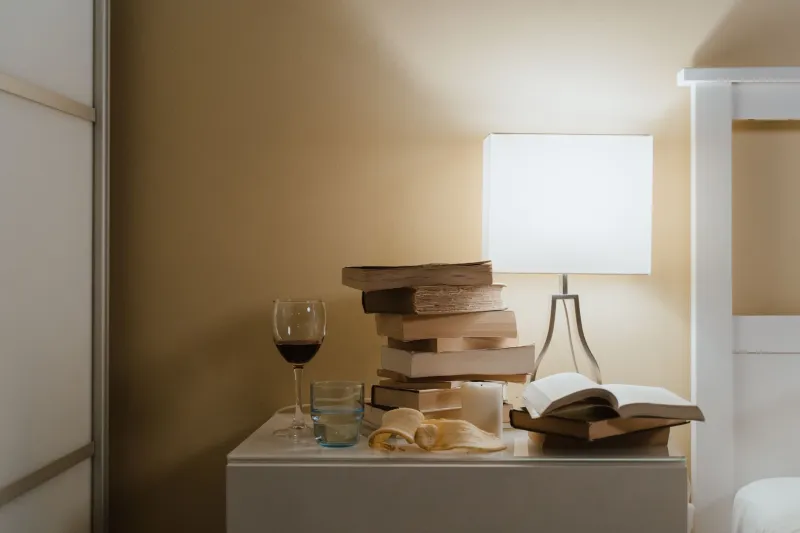
You don't need to redesign your home to experiment with ma. Pick one surface — a nightstand, a kitchen counter, a side table — and clear it completely. Then, if you want, place a single object there. Something you actually love. And then leave it.
Notice what happens over the next few days. Notice whether the rest of the room starts to look different. Notice whether that cleared surface starts to feel like a small exhale in the middle of your day.
The empty corner that's been bothering you? It might not need anything at all. It might just need permission to stay empty — and for you to finally let that be enough.